Micro-Inverter vs String Inverter: Which Technology Is Right for Your Roof?
Solar panels produce direct current (DC), while almost all appliances in homes and businesses run on alternating current (AC). Between the two sits one device that acts as the translator: the solar panel inverter. Without an inverter, the energy captured by the panels cannot be used to power lights, refrigerators, or production machines.
When designing a rooftop solar PV system, two technologies are most often compared: the micro inverter and the string inverter. Both convert DC into AC, but they differ quite a bit in how they are installed, how they behave under shading, and how they are monitored. Understanding these differences will help you choose a device that suits your roof conditions, rather than simply following a trend.
What Is a Micro-Inverter?
A micro-inverter is a small inverter installed directly underneath or beside each solar module. DC power from a single panel is converted into AC right at that point, and the output from all the micro-inverters is then combined through AC cabling to the building’s electrical distribution panel.
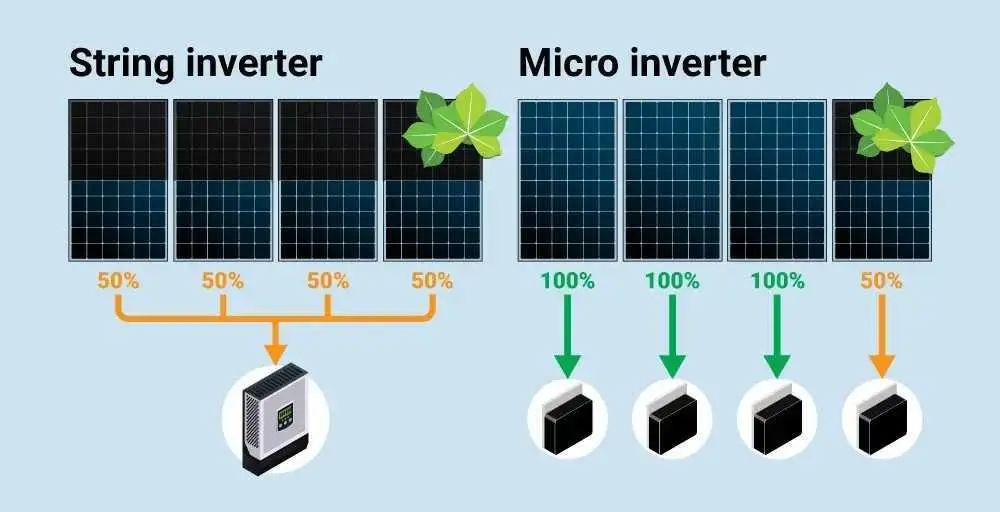
Because each panel has its own inverter, every module operates independently. Each unit has its own maximum power point tracker (MPPT), so a panel that is shaded, dirty, or facing a different direction does not drag down the output of the other panels. As a result, power production can be optimized panel by panel, especially on roofs with uneven conditions.
What Is a String Inverter?
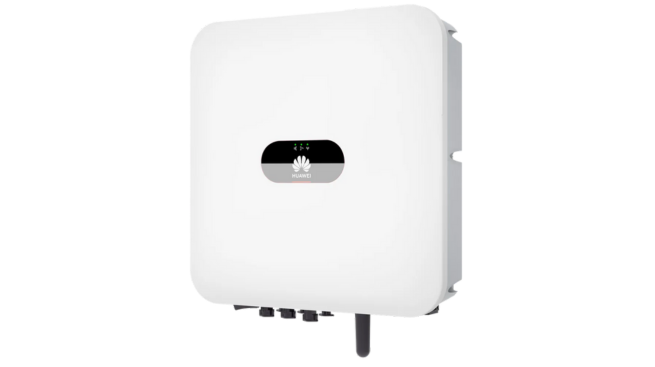
A string inverter is a single centralized inverter that receives power from a group of panels. These panels are connected in series to form a single circuit called a string. The DC voltage of all the panels in the string is added together and then fed to the inverter, which is usually mounted on a wall, in a garage, or in a technical room.
In a series circuit, the current is determined by the lowest-performing panel. If one panel is shaded, the output of the entire string can drop, although the bypass diodes inside the panels help reduce the impact. This technology has long been the industry standard and is widely used in residential PV systems, commercial buildings, and factories, especially when the roof is spacious and evenly exposed to sunlight.
Differences Between Micro-Inverters and String Inverters
Here are several aspects that distinguish the two technologies:
Installation and system configuration. Micro inverters are installed one by one on the roof, so the number of devices matches the number of panels. A string inverter needs only one unit (or several units for large systems) in an easily accessible location, but the string design must be calculated carefully so that the voltage and number of panels per circuit match the inverter specifications.
Efficiency and power production optimization. Under ideal conditions with no shading and uniform panel orientation, the conversion efficiency of both is relatively similar. The difference only becomes noticeable when panel conditions vary. In those cases, micro-inverters tend to harvest more energy because each panel is optimized individually.
Impact of shading on panels. With a string inverter, shade from trees, poles, or neighboring buildings can reduce the output of an entire string at once. With micro-inverters, the drop only occurs on the shaded panel.
Monitoring and maintenance. Micro-inverters generally provide production data per panel, so a faulty panel is quickly identified. String inverters usually only display data per string or per system, unless optimizers are added. In terms of maintenance, string inverters are easier to access because they are located at ground level, while repairing a micro-inverter requires a technician to climb onto the roof.
Investment and installation costs. String inverters are generally more cost-effective for the same capacity, especially in large-scale systems. Micro-inverters involve higher equipment costs because of the larger number of units, although this difference can be offset if the roof has a lot of shading.
Advantages and Disadvantages of Each
Micro-inverters offer panel-level optimization and design flexibility. Panels can be installed on several sides of the roof facing different directions without needing to be grouped, and the system is easy to expand simply by adding panels along with their micro-inverters. The DC voltage running across the roof is also low because the power is converted to AC right at each panel. The downsides are a higher upfront cost, more devices on the roof, and the need for roof access to replace a faulty unit.
String inverters excel in simplicity and cost. A single inverter can serve many panels, installation is more compact, and servicing can be done without climbing onto the roof. There is also a wider choice of hybrid models that can be connected directly to batteries. The downsides are that the performance of a string can be affected by shading or dirty panels, and all panels in a string should ideally have the same orientation and tilt.
Which One Is Right for Your Roof?
There is no single answer that applies to every building. Use the following considerations to determine the most suitable solar panel inverter:
- Roof size and shape. A wide roof with a single surface facing one direction is well suited to a string inverter. Roofs with many angles, small surfaces, or different orientations are easier to maximize with micro-inverters.
- Shading conditions around the panels. If your roof is often shaded by trees, water towers, or neighboring buildings at certain hours, micro-inverters can keep the output of the other panels stable.
- Required PV system capacity. For large-capacity systems such as commercial buildings or factories, string inverters are generally more cost-efficient per kWp.
- Budget and system expansion plans. If your initial budget is limited, a string inverter is usually the rational choice. If you plan to add panels gradually, the modular nature of micro-inverters can be an added advantage.
- Monitoring and maintenance needs. Choose micro-inverters if you want to monitor the performance of each panel in detail. Choose a string inverter if you prioritize practical maintenance at a single point.
FAQ on Micro-Inverters and String Inverters
Are micro-inverters more efficient than string inverters?
Not always. On an unshaded roof with panels facing the same direction, both deliver nearly the same results. A micro inverter only shows a production advantage when the conditions of each panel differ, for example due to shading or varied roof orientation.
Which is better for a roof with a lot of shading?
Micro-inverters are generally more suitable because shading only affects the covered panel, not the entire circuit. Another alternative is a string inverter equipped with optimizers on the panels most prone to shading.
Are micro-inverters easier to maintain?
In terms of monitoring, yes, because faults can be traced to a specific panel. However, in terms of physical repairs, string inverters are more practical because the unit is in an easily accessible location, whereas micro-inverters are on the roof.
Can both inverters be used for a residential PV system?
Yes. Both are commonly used in residential PV systems. The choice depends on roof conditions, the presence of shading, system capacity, battery needs, and the available budget.
Can the inverter affect how much electricity the panels produce?
Yes. The inverter determines how well the maximum power from the panels can be harvested and converted into AC electricity. Conversion efficiency, the number of MPPTs, inverter capacity, and proper string design all affect total daily energy production.
Conclusion
Micro inverters and string inverters are both reliable and each has its own advantages. Micro-inverters excel on complex or heavily shaded roofs thanks to panel-level optimization, while string inverters offer a simpler and more economical system for spacious roofs. The choice of solar panel inverter should be based on your roof conditions, level of shading, system capacity, monitoring needs, and budget.
Still unsure which type of inverter to choose for your roof? The Solar Depot team is ready to help with site surveys, shading analysis, and designing a PV system with the inverter best suited to your needs.